Pilot Cities
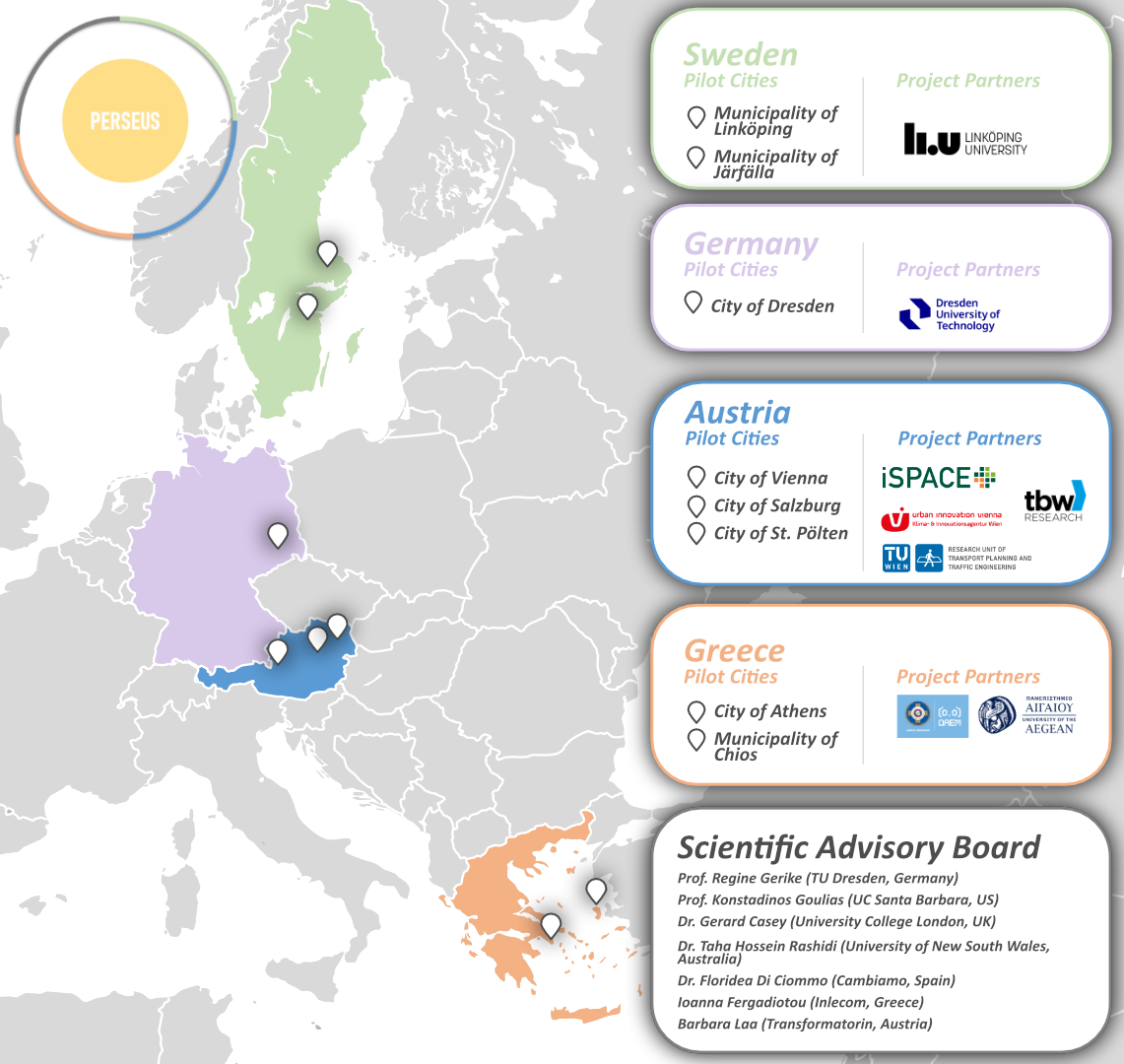
PERSEUS is tested and validated in pilot cities and Urban Living Labs across:
- Austria
- Gemany
- Greece
- Sweden
Through structured workshops, interviews and co-creation sessions, stakeholders contribute to the development and refinement of the indicators and the DSS.
Two pilot rounds ensure validation and usability:
● Round 1 – Indicator and potentiality index testing
● Round 2 – DSS usability and scenario testing
This iterative process ensures that the tool responds to real-world planning needs.
Located in the eastern Aegean Sea close to the Turkish coast, Chios is a Greek island municipality with a distinctive settlement structure shaped by maritime, rural and historic contexts.
Chios adds an island perspective to PERSEUS, with specific challenges such as dispersed settlements, seasonal population dynamics and limited public transport connectivity. The municipality is interested in using data-driven tools to improve accessibility, active mobility and local service provision in a small-scale, polycentric context.
Key facts: 32,000 residents · Climate neutrality target 2040 ·
15mC readiness: medium · Focus: island mobility, accessibility, GIS-based planning, SUMP.
Located in southern Sweden, Linköping is one of the country’s major urban centres and an important hub for education, research, technology and regional mobility.
Linköping combines a strong climate and energy agenda with ongoing work on sustainable urban mobility and comprehensive planning. The city is developing its SUMP and contributes insights into how decision-support tools, accessibility analysis and cross-departmental collaboration can help guide future mobility planning.
Key facts: 168,000 residents · Climate target 2030 · 15mC readiness: very high · Focus: SUMP, accessibility analysis, cycling, climate and energy planning.
Located in western Austria near the German border, Salzburg is the capital of the federal state of Salzburg and internationally known for its historic urban landscape and Alpine setting.
Salzburg is working towards climate neutrality by 2040 and builds on strong foundations in walking, cycling and smart city planning. As a compact historic city with a high 15-minute city readiness, Salzburg brings valuable insights into how sustainable mobility, public space transformation and climate strategies can be combined in a sensitive urban context.
Key Facts: 157,700 residents · Climate neutrality target 2040 ·
15mC readiness: high · Focus: walking, cycling, climate-neutral city.
Located in eastern Germany on the River Elbe, Dresden is the capital of the federal state of Saxony and a major cultural, administrative and economic centre.
Dresden contributes the perspective of a large German city working towards a mobility system based on short distances and sustainable accessibility. Within PERSEUS, Dresden’s role is currently being further clarified due to changes in responsibilities, but the city remains relevant for exploring data-driven and visual approaches to 15-minute city planning.
Key facts: 575,600 residents · Climate target 2030/2040 · 15mC readiness: high · Focus: city of short distances, mobility objectives, data-driven planning.
Located in north-eastern Austria, St. Pölten is the capital of Lower Austria and serves as an important regional administrative and transport hub.
St. Pölten is a Climate Pioneer City pursuing a systematic and participatory path towards climate neutrality by 2040. The city is currently developing its Sustainable Urban Mobility Plan and actively explores how short distances, active mobility and multifunctional neighbourhoods can support a more liveable urban future.
Key facts: 59,800 residents · Climate neutrality target 2040 · 15mC readiness: medium to high · Focus: SUMP, active mobility, climate neutrality.
Located in the Stockholm metropolitan region, Järfälla is a growing Swedish municipality that combines suburban neighbourhoods, green areas and major new urban development sites.
Järfälla is working towards climate neutrality and explores how the 15-minute or 20-minute city concept can support safer, healthier and more accessible neighbourhoods. The municipality brings valuable experience in connecting older car-oriented areas with newer urban developments and improving sustainable mobility options.
Key facts: 88,900 residents · Climate target 2040 · 15mC readiness: high · Focus: climate neutrality, urban transformation, car dependency, public transport.
Located in eastern Austria on the Danube, Vienna is the country’s capital and largest city, as well as a major political, cultural and economic centre in Central Europe.
Vienna brings a strong strategic framework for climate-neutral and liveable urban development. With its dense urban structure, excellent public transport network and programmes such as the Walking Master Plan, WieNeu+ and Supergrätzl, Vienna offers important experience in linking mobility, public space and urban transformation.
Key facts: 2,028,300 residents · Climate neutrality target 2040 · 15mC readiness: very high · Focus: public transport, walking, polycentric development, public space.
Located in southern Greece, Athens is the national capital and the country’s largest metropolitan centre, combining a dense urban fabric with a long historical and cultural legacy.
Athens brings the perspective of a dense Mediterranean capital facing challenges such as heat, traffic congestion and limited green space. Through resilience strategies, climate initiatives and projects such as the Athens Superblock, the city is testing approaches to improve liveability, accessibility and sustainable mobility at neighbourhood level.
Key facts: 664,000 residents / 3.15 million in the metropolitan area · Climate target 2030/2040 · 15mC readiness: medium · Focus: resilience, green infrastructure, superblocks, traffic reduction.